
Cost of Selling Air
By Claudio J. Muñoz — Founder, Partners64
A few months ago I wrote a short piece about a pattern I kept running into in the tissue business: producers trying to reduce distribution cost by trimming around the edges — less film, tighter pallet optimization, lighter secondary packaging.
Yes, those help. But they're not the real lever.
In the U.S. tissue market, distribution can represent 10 to 30 percent of delivered cost. At that level, you don't fix the problem by trimming around the edges. You fix it at the product level.
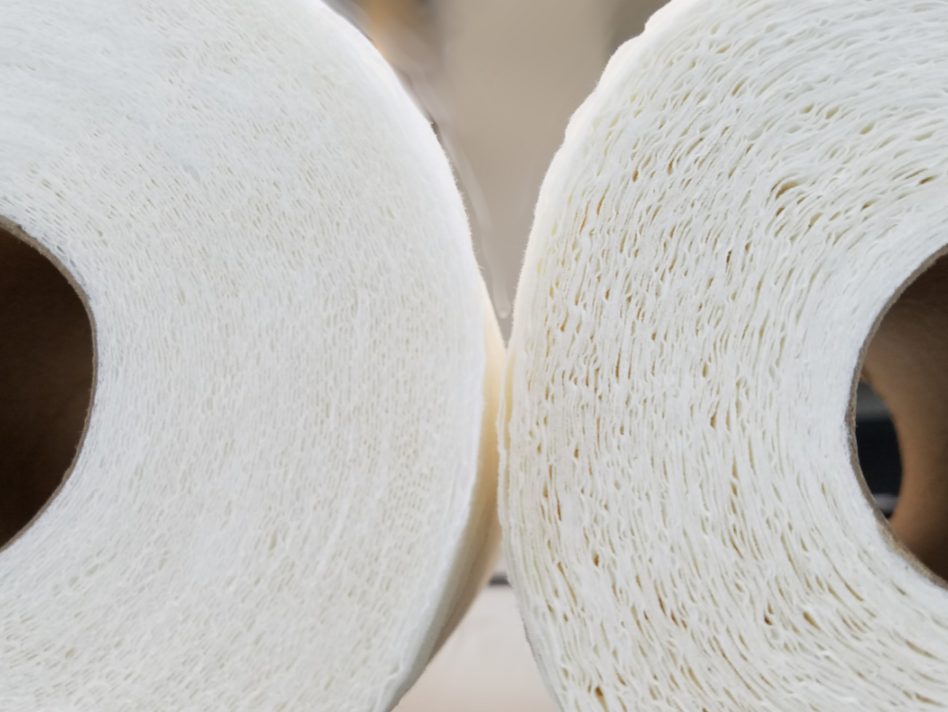
A dense product like the iconic Scott 1000 bath tissue is a model of logistical efficiency. It's heavy, compact, and moves very little air. Super-premium structured products — Charmin, Cottonelle, Quilted Northern, Bounty — sit at the other end of the spectrum. They deliver the highest consumer value through softness, bulk, and absorbency. But that bulk is, quite literally, expensive to move. It's an uncomfortable tradeoff: the products that deliver the strongest consumer value often come with some of the worst distribution economics.
What's interesting is what the leading brands are doing about it. In the U.S., Procter & Gamble has launched Charmin Mega XL, XXL, and Bounty towels with steadily increasing roll diameters. The extreme case is the Charmin Forever Roll, at roughly 1,700 sheets and a 12-inch diameter. On the surface, that looks like consumer-driven innovation — bigger rolls, fewer trips to change them. Underneath, it's something else. A higher-density roll changes the entire system: fewer cores, less packaging, and longer converting runs with fewer changeovers on the plant floor; better density across pallets and trucks in the warehouse; fewer trucks, less handling, and a lower cost per use everywhere after that. We like to say we're following the consumer toward larger formats. The reality is more pragmatic. You cannot optimize your way out of a low-density product, and as material, labor, and freight costs keep climbing, the industry is reaching a point where it isn't just giving the consumer what they want — it's redesigning the product because the economics of selling air are no longer sustainable.
I posted that argument on LinkedIn, and the conversation that followed pushed the thinking further in a few directions I hadn't fully covered.
The first is that freight cost is only part of the bill. One comment, from someone with a background in pulp and sustainability strategy, made the point that if you priced in carbon and water footprint alongside distribution cost, the conclusion gets sharper, not softer. Today's brightness, softness, and bulk standards barely account for footprint at all — it isn't in the price, and it isn't really in the consumer's field of view either. If it were, we'd probably tolerate a bit less brightness, a bit more density, maybe even the occasional visible fiber speck, without actually giving up performance. Distribution cost is the argument that gets an executive's attention first, but it isn't the only cost this format decision is hiding.
The second is that this isn't unique to tissue. Someone in commercial hygiene pointed to Hagleitner's long-standing focus on super-concentrated consumables — chemicals and paper both — as the same logic applied one category over: optimize consumption, not just distribution. Fewer refills, fewer service trips, less waste. Different lever, same conclusion. Economics drives the efficiency, and the sustainability story comes along for the ride rather than leading it. Someone else framed it well from the supply chain side: freight rewards usable volume, not shelf softness. Product density isn't a formulation choice anymore, it's a supply chain design choice, and smart tissue innovation is going to have to balance comfort against cube efficiency rather than treating comfort as the only variable that matters.
The third is the reminder that none of this is as simple as "make it denser and the market will follow." Someone described trying to introduce compact three-ply kitchen rolls into the German retail market years ago and getting nowhere — the category wasn't ready, whatever the logistics math said. Her instinct, and I think it's right, is that the fix isn't just a better product, it's a pricing signal: charge more for the soft, bulky version relative to the compact one, and let the price teach people what the logistics already know. Left alone, consumer habit doesn't reorganize itself around a supply chain's cost structure.
And the fourth is that the U.S. answer isn't the global answer. A paper executive in Brazil pushed back gently on the big-roll framing by pointing out how different the calculus looks in a market with real internal disparity — national per-capita tissue consumption in Brazil is a fraction of the U.S. figure, and the south of the country consumes like a developed market while the north looks more like an emerging one. In that kind of market, the lever isn't necessarily a bigger roll, it's regionalization: efficient equipment placed close to the markets it actually serves. Same underlying problem, different fix, because the market itself isn't uniform.
Put together, none of this changes the core point, it sharpens it. The roll diameter, the footprint math, the pricing gap, the plant location — they're all the same decision wearing different clothes: how much of the true cost of "softness" are you willing to make visible, and to whom. We tell ourselves we're following the consumer toward bigger, softer, bulkier formats. I think the more honest version is that the economics finally caught up with a product category that had been selling air for a long time, and the consumer is being invited to follow, not the other way around.
If you've had to make this tradeoff in your own category — not just tissue — I'd be curious how you framed the decision, and who in the room had to be convinced first.
This piece grew out of a LinkedIn post and the discussion that followed. The original thread is still there.
Join the discussion on LinkedIn →
Engineer, marketer and strategist with 20+ years leading innovation and commercial growth in pulp, paper and packaging across North America, Latin America, Europe, Asia and Africa.
More about Claudio →