
Essity Is Rethinking Consumer Tissue. The Bigger Question Is Why.
By Claudio J. Muñoz, Founder, Partners64
After decades of product innovation, the balance of competitive advantage in consumer tissue is shifting. Brands and product performance still matter, but manufacturing economics, fiber flexibility, and operating model matter more than they once did.
Essity's decision to initiate a strategic review of its Consumer Tissue business deserves attention precisely because this is not a distressed operation. In 2025, the business generated SEK 43.5 billion in sales, an EBITA margin of 11.9%, and return on capital employed of 14.7%. It leads the European market and holds the number-two position in Latin America. Essity describes the business as having strong brands, leading market positions, and an efficient supply chain. No decision has been made: the company says the review is evaluating different ownership alternatives and could lead to a separation.
The capital-allocation logic is easy to see. Essity targets annual organic growth of 1–2% and an EBITA margin above 12% for Consumer Tissue, versus group targets above 3% growth and above 15% EBITA. Professional Hygiene carries higher margin ambitions, while Personal Care and Health & Medical have higher growth targets. A good tissue business can therefore be relatively less attractive when competing for capital inside a diversified hygiene company.
But Essity's review raises a broader question: what creates competitive advantage in a mature tissue category today?
Moving the Ceiling While Raising the Floor
The major consumer-products companies spent decades engineering fiber blends, refining, chemistry, sheet structure, drying, embossing, and converting to create meaningful differences in softness, strength, absorbency, and bulk. Through-air drying, or TAD, became one of the clearest North American examples, especially in premium towel and bath tissue. It helped create products that conventional tissue machines could not easily reproduce.
Companies such as Procter & Gamble and Kimberly-Clark also built enormous R&D capabilities extending beyond tissue into diapers, feminine care, incontinence, nonwovens, and other personal-care categories. The ambition was not limited to making toilet paper incrementally softer. They were exploring what else tissue could do and whether the category could move further toward hygiene, personal care, or health.
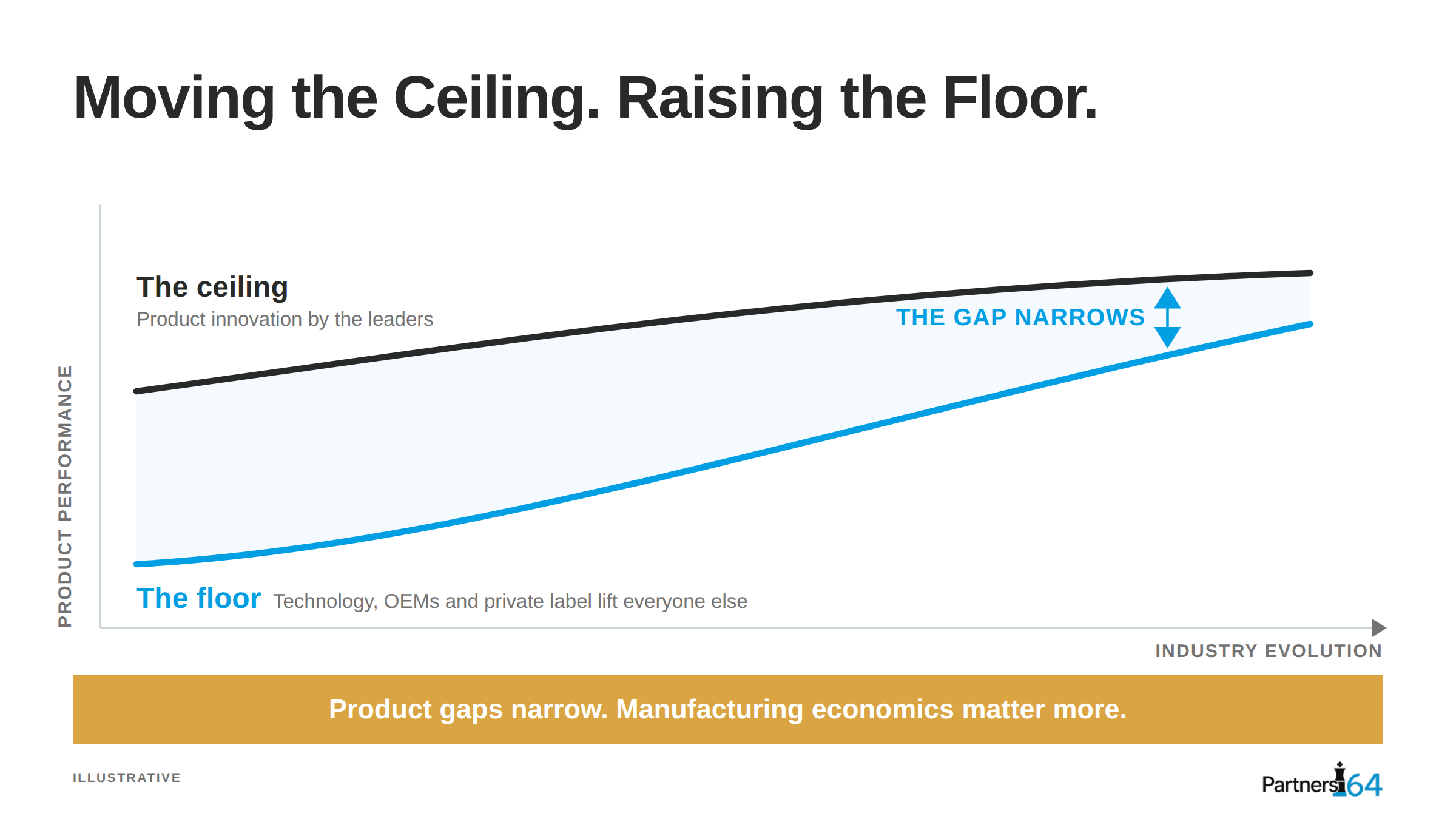
The traditional leaders were trying to move the ceiling. At the same time, the rest of the industry was steadily raising the floor.
The ceiling has continued to move, but the nature of that innovation has changed. Over the last decade or two, much of the incremental advantage has come from productivity — better equipment, energy efficiency, fiber utilization, process control, and converting — while truly breakthrough product innovation has been less frequent. Meanwhile, those same advances have helped the broader industry raise the floor and close part of the competitive gap, as illustrated in Figure 1.
One reason is that sophisticated technology has become available to a much broader manufacturing base. OEMs and suppliers such as Valmet, Voith, Andritz, BW Converting, Futura, Gambini, and others have continued advancing papermaking, structured-tissue, and converting technology. A manufacturer still needs the product knowledge and operating capability to use that equipment well, but it no longer has to invent every piece of the technology itself.
Sofidel illustrates the point. Following its acquisition of Clearwater Paper's tissue business, which included existing TAD assets, Sofidel is investing another $775 million in Oklahoma, including a new 75,000-tonne-per-year Valmet TAD machine. Sofidel, now the fourth-largest tissue producer in North America and a private-label leader, explicitly links the investment to a market increasingly oriented toward premium products, including private label.
Other technologies have attacked the performance gap differently. Systems such as NTT and ATMOS, combined with advances in chemistry, process control, and converting, provide additional routes to improve bulk, softness, and absorbency. From my own experience around tissue converting equipment, heated embossing and increasingly sophisticated converting technologies can push a conventional sheet further in structure, bulk, and tactile perception. These products are not equivalent to the best true TAD products, in my view, but competitively they do not need to be.
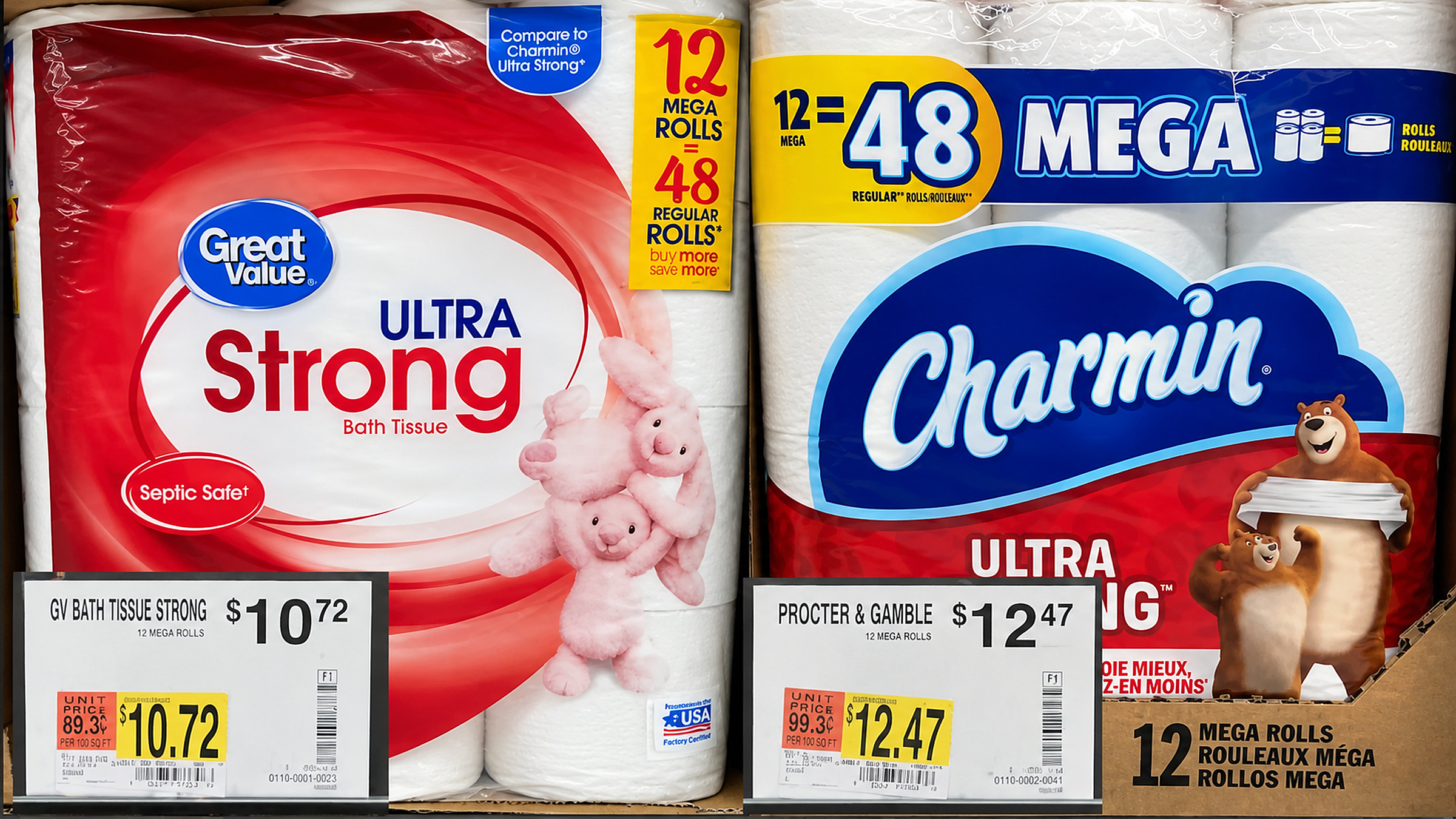
A private-label product does not have to outperform Charmin or Cottonelle to change the value equation. It has to deliver enough performance that the remaining difference becomes harder to justify at a significantly higher price, as the comparison in Figure 2 illustrates.
Europe reached a similar competitive question through another route. TAD never became as prevalent there as it did in the North American premium market, with its higher energy requirements being one factor. In my experience, European retailers also developed powerful private-label tissue businesses much earlier. Raising the floor has not followed one global formula: North America has seen premium manufacturing technology spread across a broader group of producers, while retailer power and private label have long played a larger role in Europe.
The ownership architecture has been changing as well. Essity itself emerged from SCA, which had consolidated major European tissue assets previously owned by P&G and Georgia-Pacific. More recently, Kimberly-Clark moved most of its international Family Care & Professional business into Arbex, a Suzano-controlled joint venture that operates across many of the same international tissue markets.
As the Quality Gap Narrows, Economics Matter More
Product-performance convergence is not brand convergence. Strong tissue brands carry familiarity, trust, distribution power, and consumer preference. A technically excellent private-label product does not suddenly acquire decades of brand equity.
What changes is the burden placed on that premium. As physical alternatives improve, the brand and product together must continue giving consumers a reason to pay more.
This is why I believe much of the meaningful innovation in tissue is moving behind the sheet. Fiber flexibility, energy, OEE, converting performance, product density, packaging, and logistics may not produce dramatic new claims on the package, but they can fundamentally change the economics of producing it.
Fiber is a good example. Earlier in my career, I worked on tissue fiber optimization programs around the world, where we evaluated different fibers and furnish strategies through the entire manufacturing system. A fiber change affects refining, chemistry, drainage, strength, softness, machine efficiency, and converting performance. That taught me something I believe strongly today: the competitive advantage is not simply access to lower-cost fiber. It is fiber flexibility — the ability to change the furnish as fiber economics change without giving back the savings through lower productivity or poorer product performance.
Substitution is not plug-and-play. Reducing higher-cost long fiber, for example, can require changes in refining, wet-end chemistry, process control, and converting to maintain strength, softness, and runnability. The advantage belongs to manufacturers that can operate across a wider fiber window while delivering the product consumers expect. Alternatives to higher-cost long fiber exist, but running them consistently at scale while maintaining product performance is where the real capability resides.
That makes the structure of Arbex particularly relevant. Suzano brings industrial manufacturing and fiber expertise, while Kimberly-Clark contributes leading brands and commercial capabilities. Kimberly-Clark expects the combination to reduce total delivered product costs while also reducing its own exposure to volatile input costs.
Owning pulp does not automatically create an advantage in tissue. The potential is in how these capabilities work together — fiber knowledge, furnish flexibility, tissue manufacturing, brands, and commercial execution. Whether that model ultimately creates an advantage remains to be seen. But it illustrates how capabilities that historically often sat inside one branded consumer-products company can now be recombined.
The same logic extends beyond fiber. Better OEE, lower energy use, fewer converting interruptions, improved packaging, and greater cube efficiency create value even when the consumer sees essentially the same product.
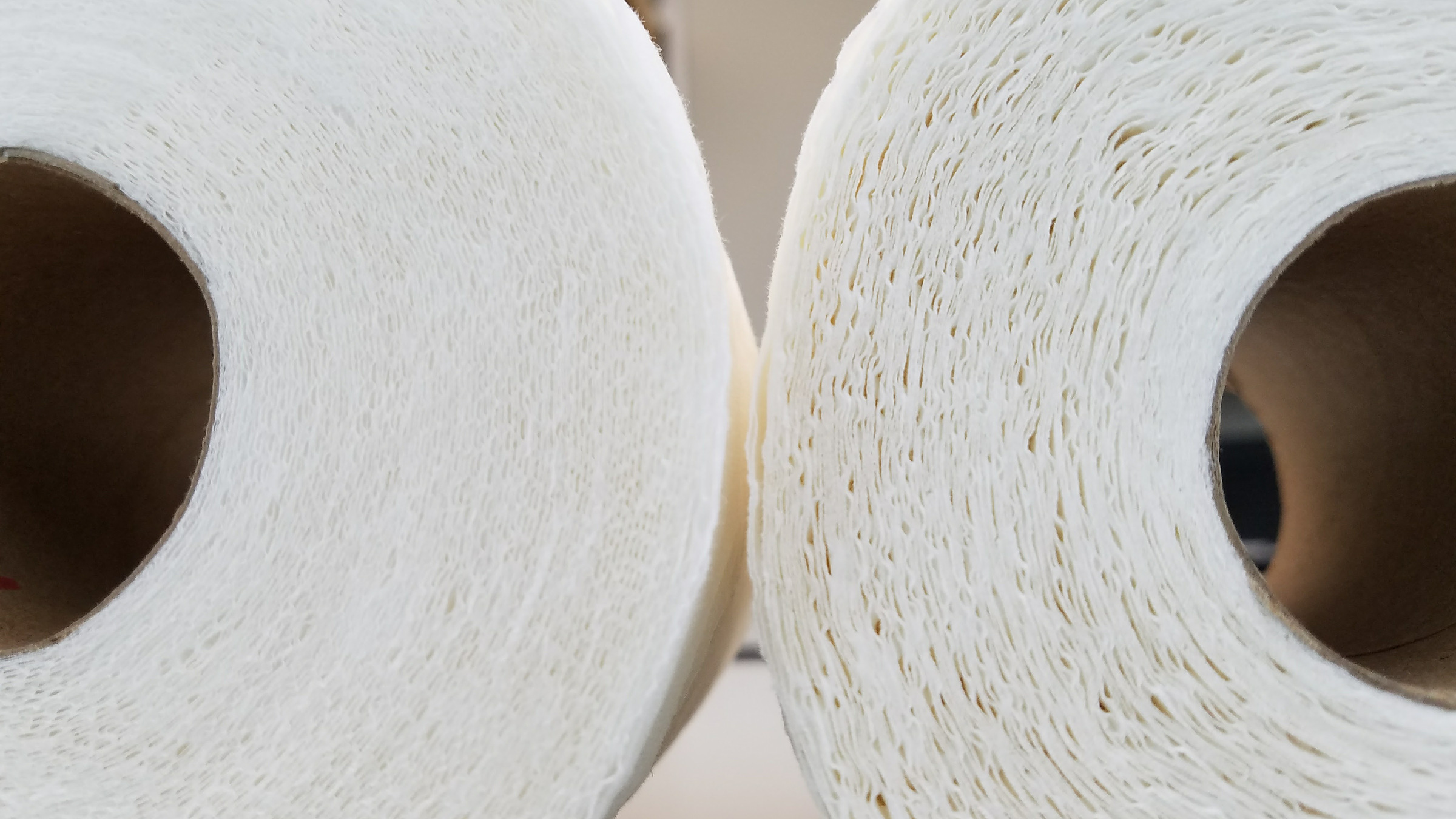
Product density makes this especially visible (Figure 3). Softness and bulk create real consumer value, but bulk also occupies space. Pallets cube out, warehouses fill, and trucks transport relatively lightweight packages occupying substantial volume. I think of this as the cost of selling air. Larger rolls, denser formats, better converting, and more efficient packaging can reduce that burden while improving production runs, changeovers, and asset utilization.
Essity's Professional Hygiene business offers a useful contrast. Tork PeakServe uses compressed refills and high-capacity continuous dispensing to reduce storage and refill interventions. In Professional Hygiene, those efficiencies can become part of the customer proposition because facility managers and cleaning contractors directly experience labor, storage, and replenishment costs. A household buying toilet paper does not directly see the manufacturer's freight bill. The same efficiency can therefore have very different commercial value depending on who makes the purchasing decision.
The Ownership Question
For decades, major branded tissue companies often placed consumer insight, R&D, proprietary technology, manufacturing, converting, marketing, and distribution inside the same organization. That model works. P&G's continuing commitment to premium branded tissue in North America is an obvious example.
But it is no longer the only credible model. Focused tissue manufacturers can compete through modern assets, high OEE, and operational intensity. Private-label specialists combine strong product performance with retailer relationships and value. Arbex combines fiber and industrial expertise with tissue manufacturing, brands, and commercial capabilities.
The capability that is scarce is not necessarily the same in every market.
That brings the discussion back to Essity. Its strategic review concerns a market-leading business with substantial scale, established brands, and an efficient supply chain. The question is not whether Consumer Tissue is a good business. The question is how it fits inside Essity when other parts of the company carry higher growth or margin ambitions, and when competitors are organizing around different combinations of brands, fiber, manufacturing, and scale.
The natural owner of an asset can change even when the asset itself remains good.
The industry's historical leaders created advantage by pushing product performance beyond what competitors could reproduce. That capability still matters, especially in premium North American tissue. But the floor has risen: more manufacturers can now deliver very good products, and the economics behind those products have become increasingly important.
If the industry has become so effective at raising the floor, who will invest in moving the ceiling again — and will consumers be willing to pay for it?

Engineer, marketer and strategist with 20+ years leading innovation and commercial growth in pulp, paper and packaging across North America, Latin America, Europe, Asia and Africa.
More about Claudio →